

Key Takeaways
- In 2026, the average cost of a direct mail campaign is between $0.45 and $3.00 per piece. This all-in cost includes five distinct line items: postage, printing, lettershop/mail prep, data hygiene, and mailing list acquisition.
- The mailing list has more influence on your return on investment than any other cost component. While postage and printing determine what you spend, the quality and targeting of your list shape what you get back.
- Every Door Direct Mail (EDDM), also known as saturation mailing, offers a lower cost per piece but is not always cheaper per response. For businesses serving specific customer segments, a targeted mailing list can produce a lower cost per qualified lead; a test mailing will show whether it does for your offer.
- The single largest per-piece saving comes from meeting USPS presort minimums (200+ pieces for Marketing Mail), which can reduce postage by over 40%. The largest per-response saving comes from filtering your list to match your offer.
- Your real cost per piece is your total campaign spend divided by the number of pieces that actually reach a deliverable, relevant address. A cheap list with a high undeliverable rate quietly inflates your real cost per piece.
In 2026, a direct mail campaign costs between $0.45 and $3.00 per piece, depending on the format, volume, mail class, and list source. This range is built from five distinct budget lines: postage, printing, lettershop services, data hygiene, and mailing list acquisition. Lumping them into a single per-piece number hides where you have leverage.
When a campaign underperforms, the instinct is to blame the offer or the creative. The real issue is often a list with a high undeliverable rate or poor targeting that inflates cost-per-acquisition before the first piece ever lands. Four of the five cost components affect what you spend. The fifth your mailing list also shapes what you get back, because it decides who receives the offer and creative in the first place.
This guide breaks down each cost component, shows how format and volume shift pricing, and explains why your list choice changes your real campaign cost more than any other variable.
The Five Line Items in Every Direct Mail Campaign
Every direct mail campaign budget comes down to five distinct costs. Looking at them separately is the difference between budgeting with confidence and getting surprised by the final invoice. Postage is usually the largest line item, but once you choose a mail class, it is also the least variable. Printing and the mailing list are where costs tend to move the most.
To build your own planning figure, add the per-piece cost of each line using the ranges in this guide: postage based on your mail class and sortation tier, printing based on format and run length, the list price per record, lettershop services, and data hygiene. Together, those five numbers give you your all-in cost per piece.
Postage: The Largest Line You Control the Least
Postage is a predictable cost because the USPS publishes all rates. The rate you qualify for depends on mail class, sortation depth, and automation compliance. For a presorted letter, the USPS Marketing Mail rate at the Mixed AADC (Automated Area Distribution Center) tier is $0.467 as of July 2026, a 43% savings compared to the retail First-Class rate of $0.82. To get this rate, you need a mailing of at least 200 pieces and a bulk mail permit. Your mail service provider runs your list through CASS (Coding Accuracy Support System) certification and applies an Intelligent Mail barcode (IMb) to each piece to meet automation requirements.
Printing: Format, Paper, and Run Length Set the Range
Printing costs for a single piece can range from $0.08 for a standard postcard on a large run to over $0.45 for a complex letter package on a small run. The main drivers are paper weight, ink coverage, and quantity. A run of 1,000 pieces can cost nearly twice as much per piece as a 10,000-piece run because the press setup cost is amortized across fewer units. Variable data printing personalizing each piece with a name, offer, or image typically adds $0.02 to $0.05 per piece.
Common Per-Piece Printing Cost Ranges (10,000-piece quantity):
- 4×6″ Postcard: $0.08–$0.16
- 6×9″ Postcard: $0.08–$0.14
- #10 Letter with Envelope: $0.20–$0.45
- 6×11″ Jumbo Postcard: $0.12–$0.20
Lettershop and Mail Prep: The Cost of Getting It Into the Mailstream
Lettershop services are the physical work of preparing your mail for USPS induction. This includes inkjetting addresses, applying IMb barcodes, sorting mail into trays or sacks for postal discounts, and delivering it to the correct USPS entry point. For a simple postcard, this costs $0.03 to $0.08 per piece; for a letter with inserts, it can run $0.05 to $0.15. It’s important to clarify if this fee is bundled into a vendor’s printing quote or billed as a separate line item, as the difference can make vendor comparisons misleading.
Data Hygiene: The Line Item That Prevents Waste on Every Other Line
Data hygiene is the process of cleaning your mailing list to ensure deliverability. It typically costs $0.01 to $0.03 per record and includes National Change of Address (NCOA) processing, CASS certification to standardize addresses, and Delivery Point Validation (DPV) to confirm an address exists. The USPS Move Update standard requires mailers to process lists through NCOA Link within 95 days of mailing. Skipping this step doesn’t save money; it just shifts the cost to wasted postage and printing on undeliverable pieces. NCOA processing and CASS certification solve different problems: CASS standardizes an address format for automation rates, while NCOA updates addresses for people who have moved. A list can be CASS-certified and still have a high undeliverable rate if it hasn’t been recently processed for moves.
Where the Mailing List Comes From and Why It Matters for Cost Per Response
The mailing list is the cost component with the highest leverage on campaign return. List quality its deliverability, targeting precision, and freshness matters more than its price per record. The question becomes where to source a list that is filtered, current, and priced predictably.
A subscription-based data platform such as InfoFree is one sourcing option. Instead of paying $0.05 to $0.15 per record for a one-time list rental, you can search, filter, and build multiple targeted lists without adding per-record charges on each iteration. You can search consumer records by geography, homeowner status, estimated home value, income, age, or move date, and business records by industry (SIC, Standard Industrial Classification, or NAICS, North American Industry Classification System, code), company size, sales volume, or executive title. Industry codes also help you reach verticals broad business lists can miss. Matching the list to the contract signer keeps responses relevant and cost per response down. In medical offices (SIC 8011), practice managers evaluate vendors against Health Insurance Portability and Accountability Act (HIPAA) requirements and often buy on annual service agreements. In coworking spaces (SIC 6512), operators and community managers manage local zoning and building-code obligations and sell flexible memberships rather than long-term leases. In commercial kitchens (SIC 2099), owners and kitchen managers work under local health department permits and food safety inspections and often rent kitchen space on hourly or monthly terms.
InfoFree compiles its business records in-house and runs them through a multi-step verification process before they are added. Consumer and household records are compiled from a separate set of public and proprietary sources and are not rated on the same standard. Because both record types sit in the same search, a direct mailer can test different segments for example, homeowner lead lists versus new movers in the same ZIP code to find the audience that responds best. Search and view access across campaigns (exports are governed by plan terms) lets you compare segments and refine targeting based on measured response.
When using any list for outreach, you are responsible for complying with all applicable local, state, and federal laws, and InfoFree is not liable for how you use the data.
Before you commit to a list, search and filter consumer or business records by the attributes that match your direct mail campaign and compare segment sizes.
Direct Mail Cost Per Piece by Format and Volume
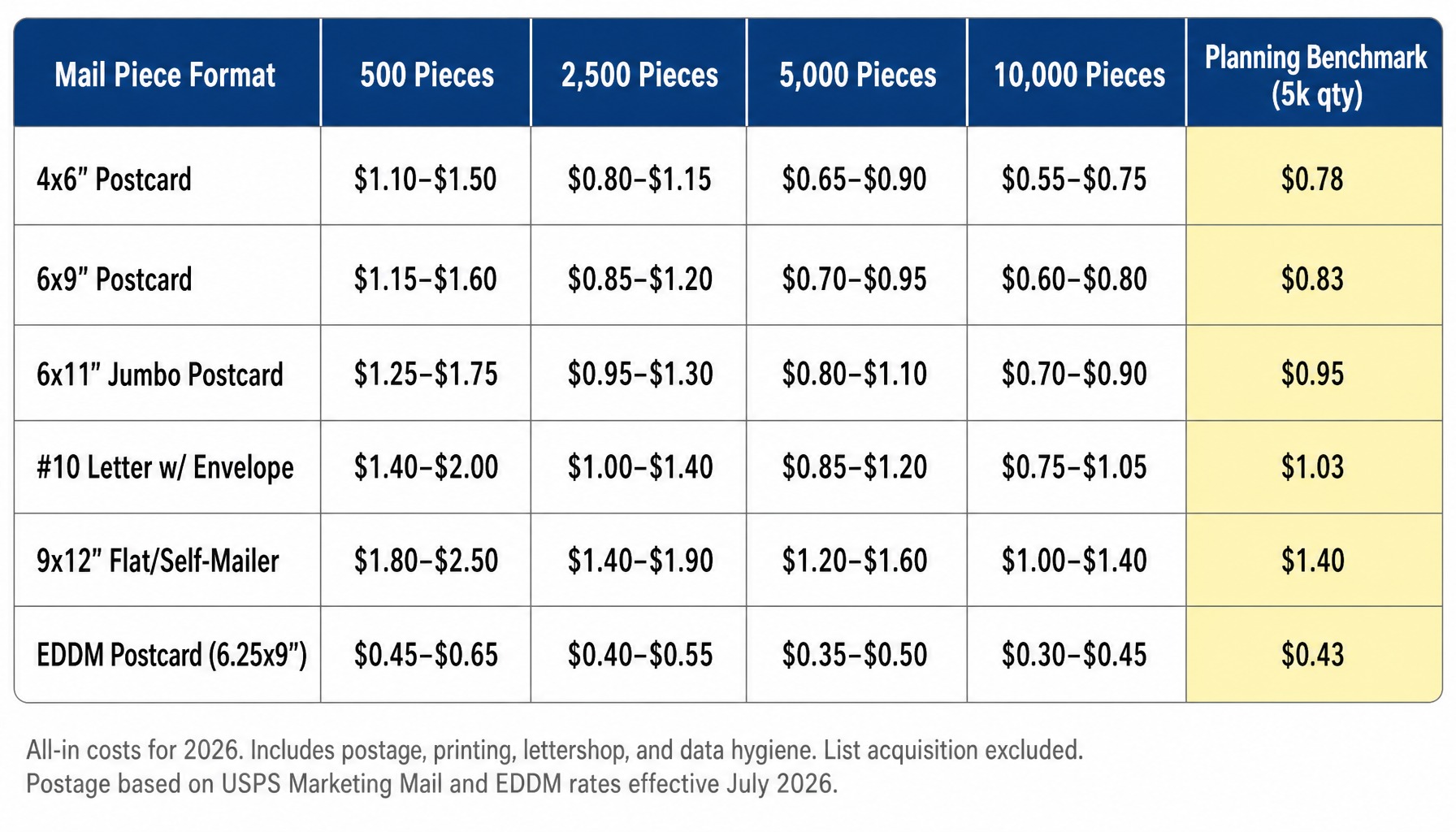
Per-piece cost is driven by two axes: format, which sets the baseline for printing and postage, and volume, which determines how far setup costs are amortized. The table below provides all-in cost ranges, excluding the mailing list, for common formats and quantities. The “Planning Benchmark” is an estimated midpoint figure you can use for initial budgeting before requesting a formal quote.
| Mail Piece Format | 500 Pieces | 2,500 Pieces | 5,000 Pieces | 10,000 Pieces | Planning Benchmark (5k qty) |
|---|---|---|---|---|---|
| 4×6″ Postcard | $1.10–$1.50 | $0.80–$1.15 | $0.65–$0.90 | $0.55–$0.75 | $0.78 |
| 6×9″ Postcard | $1.15–$1.60 | $0.85–$1.20 | $0.70–$0.95 | $0.60–$0.80 | $0.83 |
| 6×11″ Jumbo Postcard | $1.25–$1.75 | $0.95–$1.30 | $0.80–$1.10 | $0.70–$0.90 | $0.95 |
| #10 Letter w/ Envelope | $1.40–$2.00 | $1.00–$1.40 | $0.85–$1.20 | $0.75–$1.05 | $1.03 |
| 9×12″ Flat/Self-Mailer | $1.80–$2.50 | $1.40–$1.90 | $1.20–$1.60 | $1.00–$1.40 | $1.40 |
| EDDM Postcard (6.25×9″) | $0.45–$0.65 | $0.40–$0.55 | $0.35–$0.50 | $0.30–$0.45 | $0.43 |
Costs are estimates for 2026 and include postage, printing, lettershop, and data hygiene. List acquisition cost is excluded. Postage is based on USPS Marketing Mail and EDDM rates effective July 2026.
The steepest cost reduction occurs between 500 and 2,500 pieces, as fixed setup costs are spread over more units. Above 10,000 pieces, the per-piece cost flattens.
EDDM vs. Targeted Mailing List: Two Different Cost Calculations
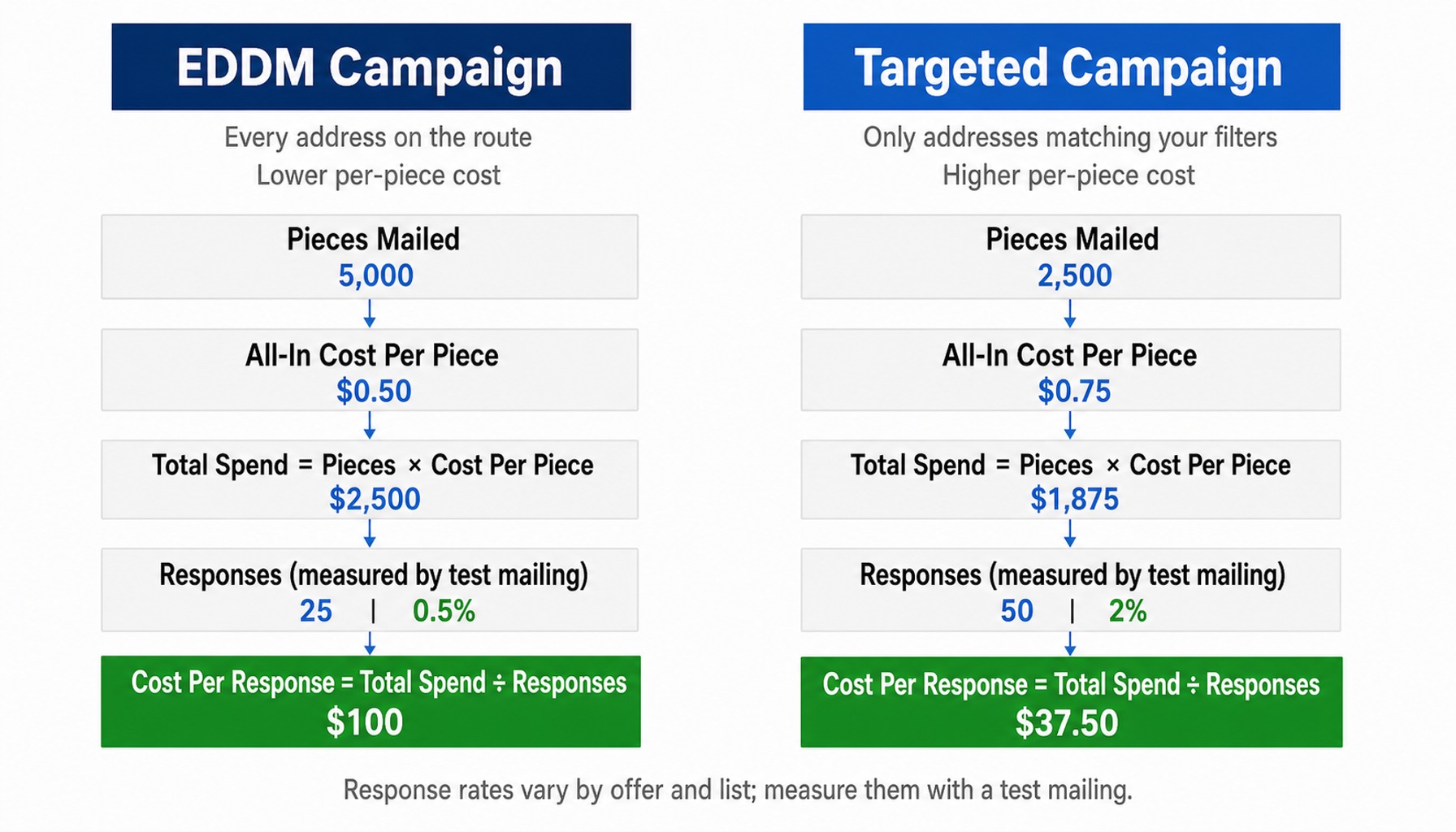
Every Door Direct Mail (EDDM) is a USPS program that eliminates the need for a mailing list. You select postal carrier routes, and the USPS delivers your mailer to every residential address on those routes. Mailing every address on a route this way is known as Saturation Marketing. The EDDM Retail postage rate is $0.226 per piece, and with printing, the all-in cost is low. A targeted mailing list costs more per piece you pay for the list data ($0.05–$0.15 per record) and higher postage but it reaches only the households or businesses that match your specific criteria.
EDDM is cheaper per piece. It is not necessarily cheaper per response.
The comparison comes down to arithmetic. Total spend for each approach is the number of pieces mailed multiplied by the all-in cost per piece. An EDDM campaign mails every residential address on the selected routes at a lower per-piece cost. A targeted campaign mails only the addresses that match your filters, such as homeowners with an estimated home value above $300k, at a higher per-piece cost but to fewer pieces. InfoFree’s platform is built for self-service targeted list creation. If you need broader saturation-style coverage, the sales team can work with you on custom list options.
Cost per response then depends on the response rate each approach achieves, which only a test mailing can tell you. Divide each campaign’s total spend by the responses it produces. A mailing with a lower per-piece cost can still carry a higher cost per response if a smaller share of its recipients respond.
EDDM is a fit for businesses that serve nearly every address on a route, like a pizza shop or a new local retailer. A targeted list is a better financial decision when your offer applies to a defined segment, such as insurance for seniors, HVAC services for older homes, or financial planning for high-income households.
How Mailing List Quality Changes Your Real Cost Per Piece
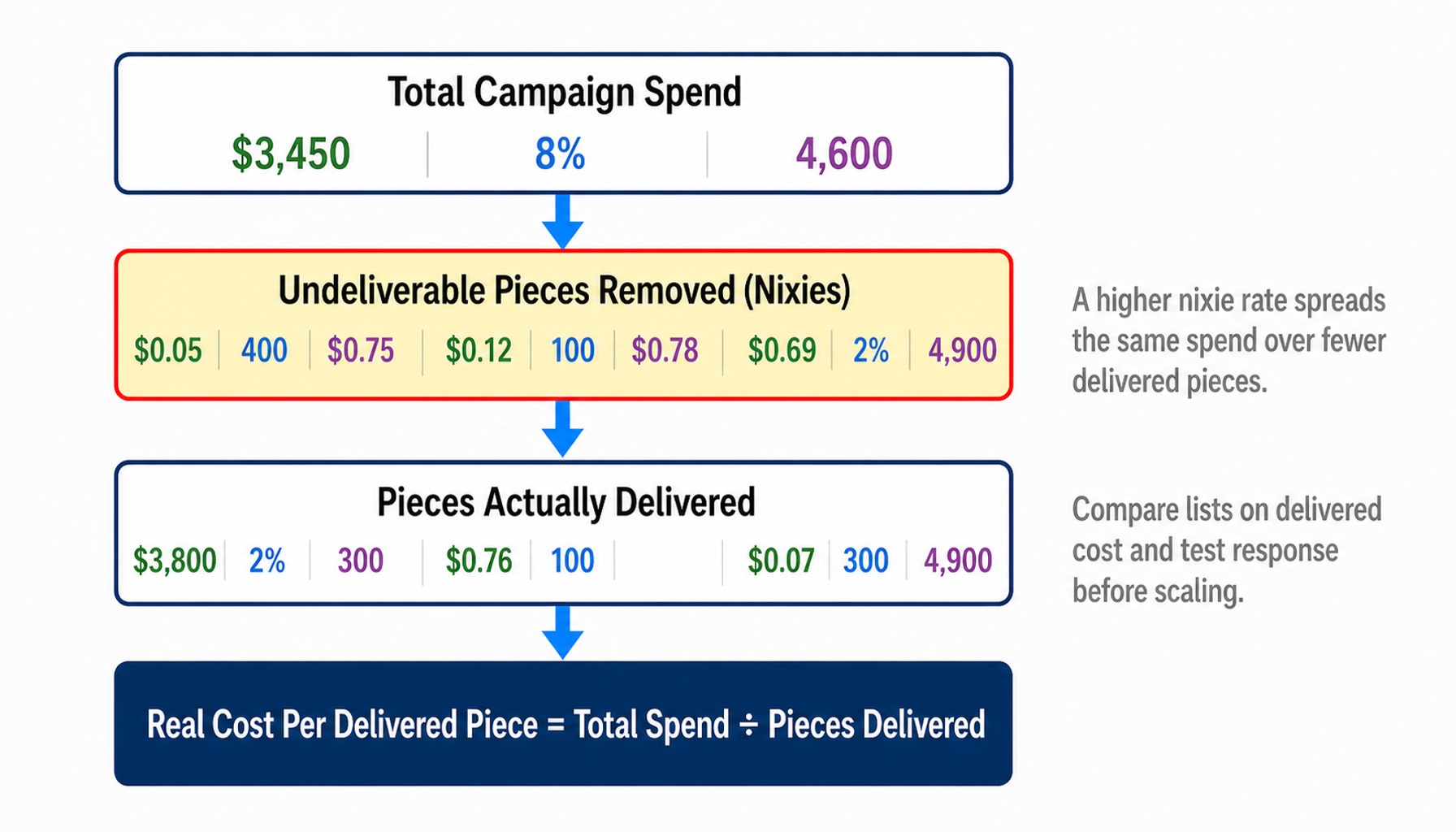
The per-piece cost on your invoice is not your real cost per piece. Your real cost is the total campaign spend divided by the number of pieces that actually reach a deliverable, relevant address. A cheap list with a high “nixie” rate mail that is undeliverable as addressed wastes every dollar spent on those records.
If a list vendor’s records haven’t been run through NCOA processing recently, part of the file will be undeliverable, and on a 25,000-piece postcard mailing every 1 percent of nixies is 250 pieces that never arrive. The postage and printing on those pieces are gone. The less visible damage is to your reporting: if you calculate response rate against pieces mailed rather than pieces delivered, the rate understates how the delivered mail performed, and you may cut a segment that is working.
Applied to the lists you are considering, a higher nixie rate spreads the same spend over fewer deliverable, relevant addresses, so it narrows the price advantage of a low-cost list against one that has been recently NCOA-processed.
On delivery alone, a cheaper list can still come out ahead per delivered piece if its price discount is larger than the cost of its extra undeliverable pieces. A quality list earns its price only if its targeting produces enough additional responses to close that gap, which is something to test rather than assume.
Read more: ZIP Code Mailing Lists – Buy Mailing Lists by ZIP Code from Infofree
Hidden Costs That Do Not Appear on the Initial Quote
A quote from a print-and-mail vendor covers the core costs, but several other expenses can appear on the final invoice. Budgeting for these ahead of time prevents surprises.
- Merge-Purge Processing: If you combine a purchased list with your own customer file, you must run a merge-purge to remove duplicates. This costs $0.01–$0.02 per record and is essential to avoid mailing the same person twice.
- Seed List: Mailing 10–25 pieces to your own “seed” addresses lets you verify delivery timing and quality. It’s a small cost that can catch a major production error before thousands of pieces are mailed.
- Variable Data Printing Setup: For complex personalization beyond a name and address, expect a one-time setup fee of $50–$200 from your print vendor.
- Tracking Infrastructure: Using QR codes, personalized URLs (PURLs), or call-tracking numbers to measure response adds $0.02–$0.10 per piece, depending on the provider.
- Returned Mail Processing: The USPS charges for Address Correction Service (ACS) notifications on returned mail. If you plan to update your house file based on these returns, budget for the staff time to process them.
How to Reduce Per-Piece Cost Without Cutting List Quality
Cost reduction falls into two categories: production savings that reduce what you spend per piece, and list improvements that reduce what you spend per response. The first has a ceiling; the second compounds.
- Hit Presort Minimums. This is the single largest saving available. A mailing of 200 or more pieces qualifies for USPS Marketing Mail rates, dropping postage from the retail First-Class letter rate of $0.82 to as low as $0.467. On 10,000 pieces, that’s a savings of over $3,500.
- Use Deeper Postal Entry. Ask your lettershop about dropping mail directly at a Sectional Center Facility (SCF) or Network Distribution Center (NDC). This can save an additional $0.01–$0.03 per piece on presorted mail by reducing USPS transportation costs.
- Clean Your List Before Printing. Run NCOA and CASS checks before you send the file to your printer. Every undeliverable record you remove prevents wasting money on printing, prep, and postage for a piece that will never arrive.
- Filter Your List to Match Your Offer. A tightly targeted list that scatters addresses across many ZIP codes can qualify for a worse postage tier than a broader list concentrated in fewer areas. Even so, narrowing by homeowner status, income, or move date concentrates spend on prospects who match your offer, and a test mailing will show whether that lowers your cost per response. For campaigns targeting recently relocated buyers, new homeowner lists let you filter households by move date.
- Test Before Scaling. Mail a smaller batch of 1,000–2,000 pieces to a filtered segment. Measure the response, then commit your full budget only to the list segments that prove effective.
As a mailer, you are responsible for complying with all applicable local, state, and federal laws governing direct marketing, and InfoFree is not liable for how you use the data.
Your Mailing List Is the Cost You Can Control
The cost of direct mail ranges from under $0.50 to over $3.00 per piece, but that number alone doesn’t tell you whether a campaign pays off. The metric that determines if a campaign is profitable is the cost per response, and your mailing list is the input to that number you have the clearest control over. Its deliverability dictates how much of your budget is wasted on undeliverable mail, and its targeting precision dictates how many recipients are actually qualified to buy from you.
Before you request a print-and-mail quote, decide who you are mailing to and how you will verify that the list reaches deliverable, relevant addresses. Whether you need marketing lists for consumer segments or business verticals, the list decision shapes your cost per response more than the print quote does.
A free trial lets you build and review a targeted mailing list before you commit.
Frequently Asked Questions
Does personalization with variable data printing raise the cost per piece enough to matter?
Variable data printing adds $0.02–$0.05 per piece. On a 5,000-piece campaign costing $0.76 per piece, that is a 3–7% increase in total cost. Whether it matters depends on whether the personalization lifts your response rate enough to deliver a lower cost per acquisition. For a postcard, adding a first name and a neighborhood reference is often a low-cost test worth running.
What is the minimum quantity needed to qualify for USPS bulk mail postage rates?
USPS Marketing Mail requires a minimum of 200 pieces or 50 pounds per mailing. First-Class presort requires 500 pieces. Below these thresholds, you pay retail postage rates like $0.82 for a First-Class letter or $0.65 for a postcard. The jump from 199 to 200 pieces on a Marketing Mail campaign can reduce per-piece postage by over 40%.
How does direct mail cost per lead compare to digital advertising cost per lead?
Direct mail cost per lead varies by vertical, offer, and list quality, so the reliable figure is the one from your own tracked campaigns. Digital channels may show a lower cost per click, but the comparison is only meaningful when measured at cost per qualified lead or cost per acquisition. Lead quality and conversion rates vary widely between a form fill from a social media ad and a phone call from a targeted mail piece.
What factors make business-to-business (B2B) direct mail cost more per piece than business-to-consumer (B2C) direct mail?
B2B mailing lists typically cost $0.10–$0.45 per record versus $0.05–$0.15 for consumer lists, as business data requires more verification. The executive-name layer on a business record decays faster than the company-address layer, meaning a list can have a deliverable address but an outdated contact. B2B campaigns also tend to use more expensive letter formats. Postage rates are the same.
How do I calculate cost per acquisition for a direct mail campaign?
Divide your total campaign cost (all five line items) by the number of new customers acquired from that campaign. To do this accurately, you must use a tracking mechanism like a unique phone number, QR code, or offer code on the mail piece.